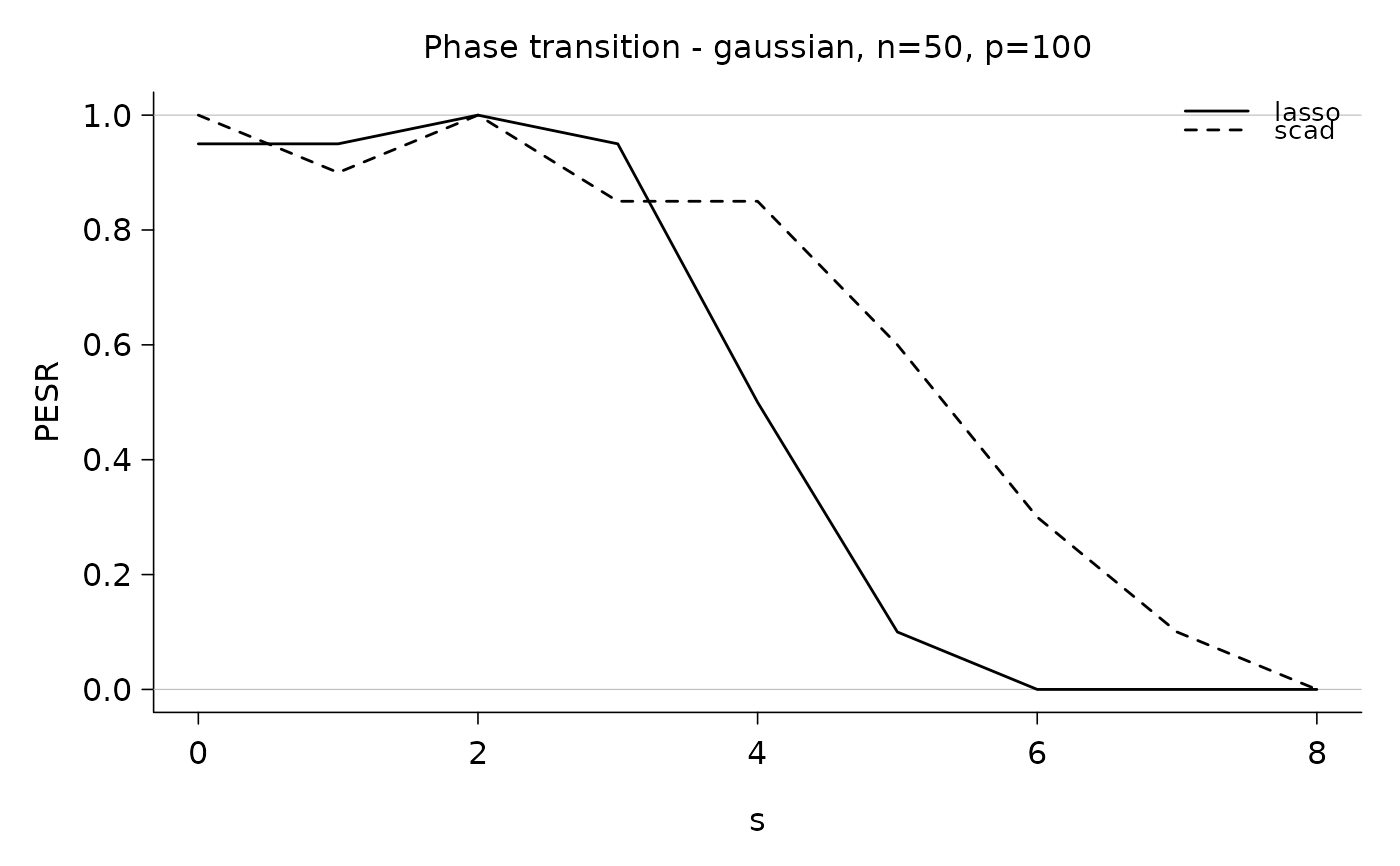
For a fixed (n, p) configuration, varies the sparsity level s
from 0 to s_max and, for each s, estimates by Monte Carlo
(m replications) the probability that pic() recovers exactly
the support of the true coefficient vector. If several penalties are
supplied, one result is produced for each (n, p, penalty) combination.
Usage
phase_transition(
  n,
  p,
  type = c("gaussian", "binomial", "poisson", "exponential", "gumbel", "cox"),
  s_max,
  m = 50,
  penalty = "lasso",
  beta_value = 3,
  lambda_method = "mc_exact",
  lambda_alpha = 0.05,
  lambda_n_simu = 5000L,
  verbose = FALSE,
  parallel = FALSE,
  workers = parallel::detectCores() - 1L
)
Arguments
- n
Integer or integer vector — number of observations per configuration.
- p
Integer or integer vector of the same length as
n— number of features.- type
Family name:
"gaussian","binomial","poisson","exponential","gumbel", or"cox".- s_max
Largest sparsity level evaluated. Must satisfy
s_max < min(p).- m
Number of Monte Carlo replications per
s.- penalty
One or more penalties for
pic():"lasso","scad", or"mcp".- beta_value
Magnitude of the non-zero coefficients used to generate the response. The sign is fixed to
+.- lambda_method
Passed to
pic(). Default"mc_exact".- lambda_alpha
Nominal level for the PDB selector.
- lambda_n_simu
Monte Carlo size for the PDB selector.
- verbose
Logical; if
TRUE, prints a one-line progress message per(n, p, penalty, s).- parallel
Logical; if
TRUE, distribute themMonte Carlo replications of each(n, p, penalty, s)cell across multiple R processes via thefutureframework (future::multisessionplan).- workers
Integer; number of background R processes to use when
parallel = TRUE. Ignored otherwise.
Value
An object of class c("pic.phase_transition", "pic.diagnostic").
- s_grid
0:s_max.- exact_recovery, tpr, fdr
Matrices of shape
(length(n) * length(penalty), s_max + 1)- one row per(n, p, penalty)curve, one column per sparsity level- curve_n, curve_p, curve_penalty
Curve descriptors aligned with the rows of the metric matrices.
- config
A list of all configuration arguments for downstream plotting / reporting.
- call
The call.
Details
At each Monte Carlo replicate a design matrix is drawn from a
standard Gaussian, s features are sampled uniformly at random,
the response is generated under the chosen type, and one pic
fit is run for each requested penalty. The selected support is
compared to the truth and three metrics are stored:
exact_recovery1 if the selected set equals the true set, 0 otherwise.
tpr\(\left|\hat{S}\cap S\right| / |S|\) - true positive rate. For
s = 0, this is set to 1 when no true feature exists.fdr\(\left|\hat{S}\setminus S\right| / \max{(|\hat{S}|, 1)}\) - false discovery rate.
Details on data sampling
At each replicate, the design \(X\) is drawn iid
\(\mathcal{N}(0, 1)\), the true support \(S\) is sampled
uniformly at random, and \(\beta_j = \) beta_value for
\(j \in S\), \(\beta_j = 0\) otherwise. The linear predictor
is \(\eta = X\beta\). The response \(y\) is then drawn
conditionally on \(\eta\) according to the requested family:
"gaussian"\(y_i = \eta_i + \varepsilon_i\) with \(\varepsilon_i \sim \mathcal{N}(0, 1)\).
"binomial"\(y_i \sim \mathrm{Bernoulli}\!\left(\sigma(\eta_i)\right)\), where \(\sigma(z) = 1 / (1 + e^{-z})\) is the logistic function.
"poisson"\(y_i \sim \mathrm{Poisson}\!\left(e^{\eta_i}\right)\).
"exponential"\(y_i \sim \mathrm{Exp}\!\left(\mathrm{rate} = e^{\eta_i}\right)\).
"gumbel"\(y_i = \eta_i + \varepsilon_i\) with \(\varepsilon_i \sim \mathrm{Gumbel}(0, 1)\), drawn as \(-\log(-\log U_i)\) for \(U_i \sim \mathcal{U}(0, 1)\).
"cox"Event times \(T_i \sim \mathrm{Exp}\!\left(e^{\eta_i}\right)\) and independent censoring times \(C_i \sim \mathrm{Exp}(1)\). The response is the 2-column matrix \(\bigl(\min(T_i, C_i),\, \mathbf{1}\{T_i \le C_i\}\bigr)\).
See also
plot.pic.phase_transition() for visualization.